FAQ
What is the Eastern New Mexico Rural Water System Project?
The Eastern New Mexico Rural Water System (ENMRWS) project includes a water intake facility to divert surface water from Ute Reservoir; a water treatment facility with an average capacity of 15 million gallons per day (mgd) and peak capacity of 28 mgd; over 90 miles of water supply pipes; and over 60 miles of lateral pipes to serve Texico, Clovis, Portales, Elida, and Cannon Air Force Base. Its purpose is to meet critical municipal and industrial water supply issues resulting from declining groundwater (aquifer) resources.
Is there really a problem with the water supply in Eastern New Mexico?
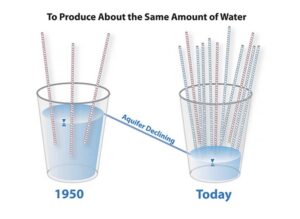 Water levels in the Ogallala aquifer below Clovis, Portales, and surrounding communities have declined in excess of 100 feet in the past decades. In addition to the decline in water level (as much as 2 feet per year in some places), there is evidence of deteriorating water quality. Aggressive private and public water conservation measures have been and continue to be implemented. However, hydrologic experts predict the groundwater supply will not be able to sustain municipal activities in the near future.
Are there other options that would cost less?
Extensive studies of water supply alternatives have been completed over the last 50 years. Studies completed in 2005 and 2006, using the most current technology and data, thoroughly evaluated the most feasible alternatives. These included 1) diverting and treating water from Ute Reservoir; 2) importing groundwater from Texas; 3) pumping and treating brackish groundwater from underlying aquifers in Curry County; and 4) continuing with the status quo (pumping groundwater from the Ogallala aquifer). The alternative to divert, treat, and convey renewable surface water from Ute Reservoir was found to have the lowest overall cost and greatest benefit.
How is the ENMRWS project being paid for?
The project is being paid for with a combination of federal, state, and local funds. The current financial model is based on a 75% federal, 15% state, and 10% local contribution. The ENMRWS project was federally authorized in 2009. This authorization allows the Eastern New Mexico Water Utility Authority (ENMWUA) to receive federal funding, which is vital to the success and completion of this project. The Authority works closely with local leaders, state legislators, and our New Mexico congressional delegation to secure continued funding for the project.
How much funding has the ENMRWS project received so far?
Recognizing the critical need for this project, the State of New Mexico, the federal government, and member communities of the ENMWUA combined have invested over $676 million for program management, design, and construction. Member communities of the ENMWUA have provided significant funding support for capital construction, programming and financial management, legal support, administrative services, debt service, and operations and maintenance. To date, the project has received $441 million in federal funds under the Bipartisan infrastructure Law (IIJA) plus earlier commitments and annual appropriations. Also, the project has secured $175 million in grants and loans through the New Mexico Water Trust Board (90% grants/10% loans). Member communities have contributed $60 million to the project.
What is the status of the design and construction of the ENMRWS project?
Design and construction has been completed on the intake structure, Finished Water One Pipeline, Finished Water Two Pipeline and the Canon Lateral, Finished Water Three A Pipeline, Finished Water Three B Pipeline and power to various facilities. Raw Water Three Pipeline and the Texico Lateral are under construction and the Water Treatment Project Pilot Project is operational. Bidding on construction of Raw Water Pipeline One A is expected to be completed this year. Raw Water Pipelines One and Two B are expected to bid construction this fall, with contract(s) to be awarded in late 2026 or early 2027. The Water Treatment Plant, Intake Pump Station, Caprock Pump Station, Caprock Storage Tank, Elida Lateral and Elida Pump Stations have been designed and are awaiting funding.
Is the water treatment facility going to cost far more than originally anticipated? If yes, why?
The water treatment of choice is membrane/Reverse Osmosis (RO) derived from months-long investigation and evaluating several treatment options by participants from each of our member communities including city managers, public works directors, elected community officials, Cannon Air Force Base, EPCOR (Clovis city water provider), water experts, and the ENMWUA.
The cost is more than a conventional treatment, but if we were to go with a conventional treatment, this would add costs to the member communities. They would have to add equipment, a chloramine system, and additional operations/maintenance (O&M) costs to accept conventionally treated water that would blend in with their existing groundwater.
Also, membrane/RO water treatment is highly effective in removing PFAS, the forever chemicals that have been discovered in Curry County. These processes typically achieve a 90-99% reduction, which ensures safe drinking water.
Additionally, if the EPA increases guidelines for drinking water in the near future for existing and emerging contaminants, additional processes (membrane/RO or granular activated carbon) would have to be added later to a conventional water treatment at a 100% cost to the ENMWUA.
The year 2031 is the year the project is expected to be operational. Will all of the member communities be ready to begin distribution of the water at that time?
Yes. Each of the ENMWUA communities has a need for additional drinking water right now. The Ute Pipeline system is designed and constructed to provide one connection point at each of the ENMWUA members’ water systems where treated, potable Ute water can be received.
How will this project affect the Ute Reservoir? Will people still be able to use it for recreation?
The Eastern New Mexico Rural Water System, which will be operated by the ENMWUA, will divert about 8% of the reservoir’s capacity to serve its member communities. While this may affect water levels, it should not prevent visitors from being able to use the reservoir for boating, fishing and swimming. Also, the Ute Reservoir was originally built in 1963 for the purpose of storing water for municipal use.
Why is this project the best solution?
For the surface water part of the portfolio, ENMWUA’s experts are working to design and construct a system that maximizes efficiency and value to the end users. That’s our commitment -- the greatest value to the residents of Clovis/Cannon, Portales, Texico, and Elida while meeting the water scarcity challenge and achieving water security.
Groundwater will always need to be part of the picture and requires investment as well. The efforts that each member community is undertaking to keep up with current demand -- sourcing groundwater supply, developing wells, maintaining water systems, etc. are costly primarily because there’s less and less groundwater available.
Will there be other costs?
Once the project is completed and operational, operation and costs will be paid for with the sale of the water to member communities.