Our Story
The Eastern New Mexico Water Utility’s history spans more than three-quarters of a century.
In 1950, the state legislatures in New Mexico, Texas and Oklahoma ratified the Canadian River Compact, which was approved by Congress and signed into law by the President in 1952.
In 1959, the New Mexico Legislature passed an Act authorizing the State Engineer to construct a dam on the Canadian River near Logan. Soon after, work began on developing and building the Ute Reservoir.
The dam was completed in 1963 by the New Mexico Interstate Stream Commission (NMISC). Today, the NMISC owns the dam and reservoir for the purpose of impounding (collecting and storing) water for municipal water use.
There have been many steps along the way.
Timeline
1960s
Planning for a regional water pipeline begins including several eastern New Mexico communities. In 1964, a feasibility study is completed on a diversion and pipeline from Ute Reservoir to communities in eastern New Mexico to serve as a supplemental source of water.
1980s
In 1987, the communities of Clovis, Elida, Grady, Logan, Melrose, Portales, San Jon, Texico and Tucumcari as well as Curry, Quay and Roosevelt Counties begin working together to build a regional water pipeline. They form a Joint Powers of Agreement to be able to reserve and purchase Ute Reservoir water from the NMISC to be delivered to their communities/areas via a regional pipeline called the Ute Pipeline Project. They call themselves the Ute Reservoir Water Commission. For more information on the purposes of the Joint Powers Agreement, click here
A few years later, Tucumcari, Logan, San Jon and Quay County withdraw from the pipeline project but keep the water allocations they had reserved. Soon after, Roosevelt County withdraws from the project and transfers its water allocation to Portales.
1990s-2015
The remaining member of the group, which had been renamed the Eastern New Mexico Rural Water Authority, continue to press forward with planning of the pipeline project and making it a federal and state priority for funding.
In 2009 the project becomes federally authorized, meaning it will be financially supported by the federal government for up to 75 percent of the cost and overseen by the U.S. Bureau of Reclamation (USBR).
In 2010, the New Mexico Legislature passes the Eastern New Mexico Water Utility Authority Act, giving the group official local government water utility authority status and structure. The group’s official name became the Eastern New Mexico Water Utility Authority. Members include Clovis, Curry County, Elida, Grady, Melrose, Portales and Texico.
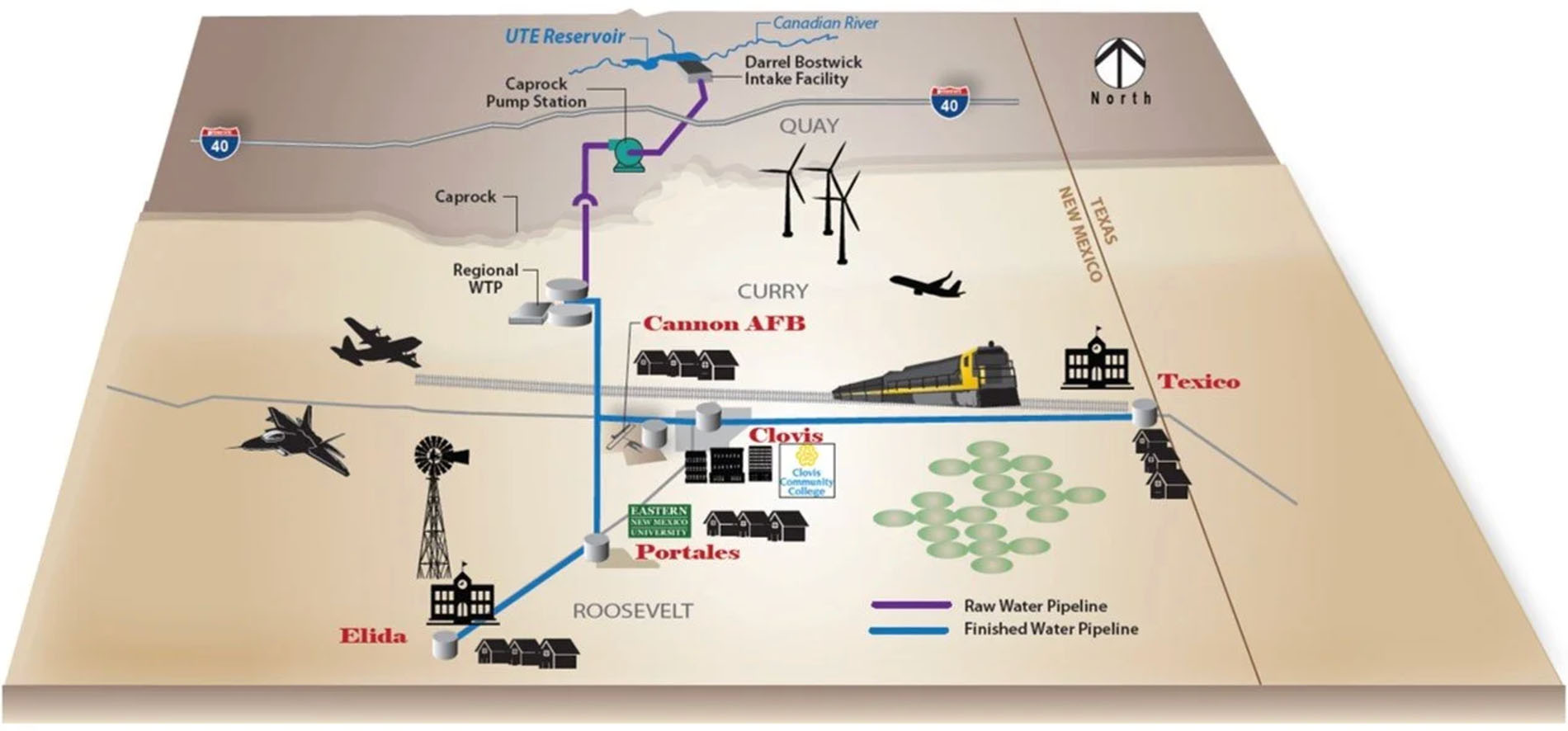
Work continues on planning and design of the pipeline, now called the Eastern New Mexico Rural Water System (ENMRWS).
2016-2020
In 2016, enough funds are collected to begin construction of the Intake Facility at Ute Reservoir.
In 2018, the first transmission pipeline segment called Finished Water Two (FW2) begins construction along a 7.5-mile stretch connecting Clovis and Cannon Air Force Base.
Since 2018, the ENMWUA has continued to receive financial support from the federal government through the U.S. Bureau of Reclamation (USBR) and state government through the Water Trust Board (WTB) program, the New Mexico Legislature and Governor, as well as from the member communities through annual contributions. Additional projects are designed.
In 2020, Curry County, Melrose and Grady withdraw from the project.
2021-2026
On November 15, 2021, the President of the United States signs into law the Infrastructure Investment and Jobs Act (IIJA), earmarking $1 billion toward completing federally authorized Rural Water projects under the USBR. The ENMWUA is among the recipients to receive funding to complete construction of the ENMRWS.
With the federal funding injection, the State of New Mexico and member communities increase their contributions and borrowing funds through the Drinking Water State Revolving Loan Fund (DWSRLF) program.
Soon after the Finished Water Two (FW2) pipeline segment is completed, ENMWUA begins construction of Finished Water Three (FW3), a 17.2-mile transmission pipeline connecting from FW2 to Portales. Finished Water One (FW1), a 15.5-mile segment connecting from FW2 and going north to the Water Treatment Plant (WTP) location begins construction.
Raw Water Three (RW3) a 21.7-mile pipeline segment that begins at the WTP location and goes north ending at the edge of the Caprock, begins construction in 2025.
As of 2026, funding is secured for all large diameter segments of the pipeline, including Raw Water One B and Raw Water Two. ENMWUA anticipates bidding these final segments of large diameter pipeline in fall 2026 and beginning construction in mid-2027.
2027-2031
All remaining facilities including the pump stations, the water treatment plant and the Elisa Lateral as well as final build out of the entire project are nearing design completion and are awaiting funding to begin construction. The project is scheduled to go online in 2031.